
An International Registration under the Madrid Protocol isn't one filing — it's one filing with a designation in every country you named. Software needs to track it that way, not as a flat list of marks.
A trademark filed directly in one country is a single, self-contained record: one application, one office, one renewal date. A trademark filed through the Madrid Protocol is structurally different — it's a single **International Registration (IR)** held with WIPO, with a separate designation in each country the applicant named. Each designation can move through examination independently: one country might grant registration while another issues a provisional refusal, on the same underlying IR.
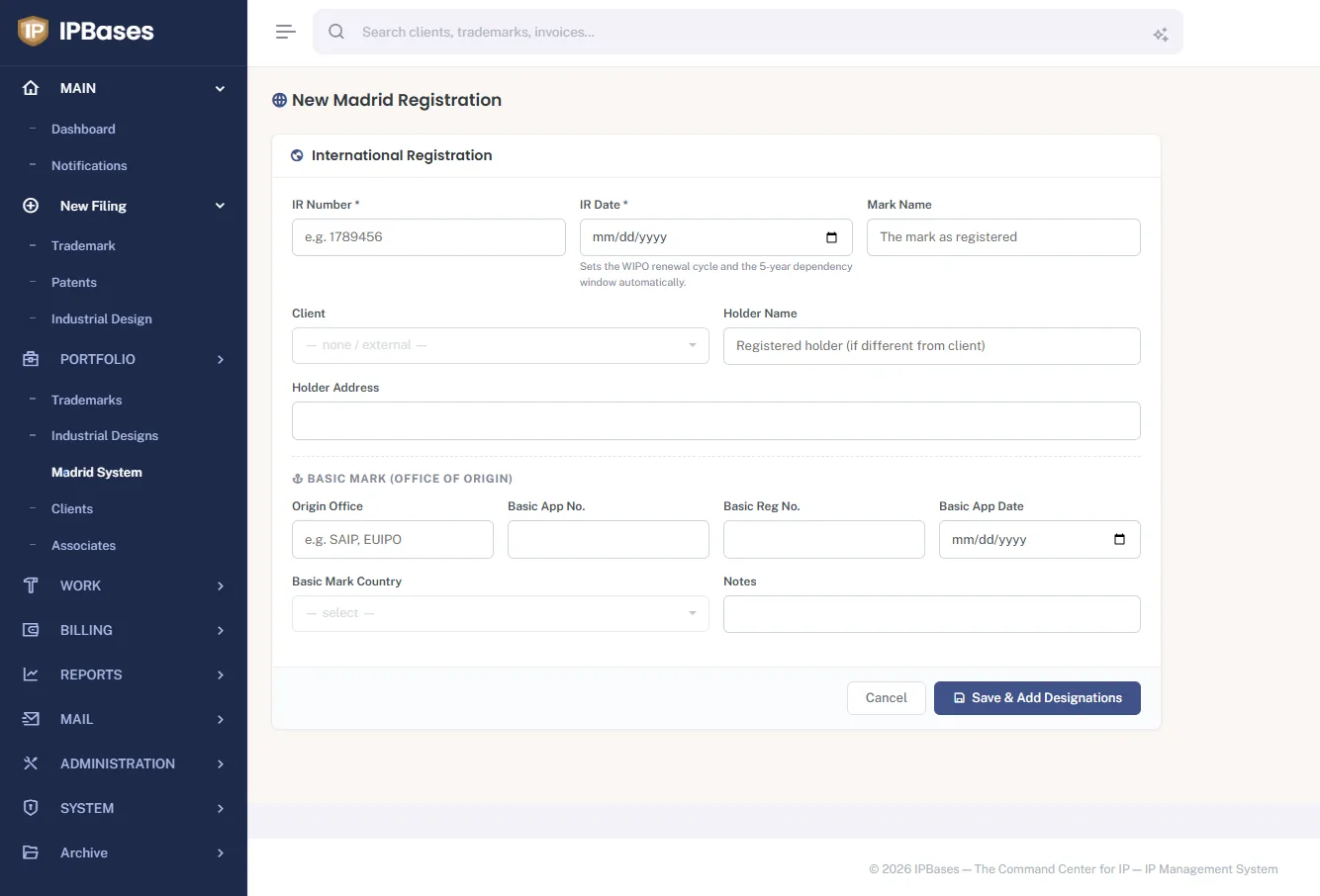
Software that treats a Madrid filing as just another row in the trademark table loses that structure. The parent-child relationship — one IR, many designations, each with its own status — needs to be modeled directly, or a firm ends up tracking it in a side spreadsheet regardless of what system they paid for.
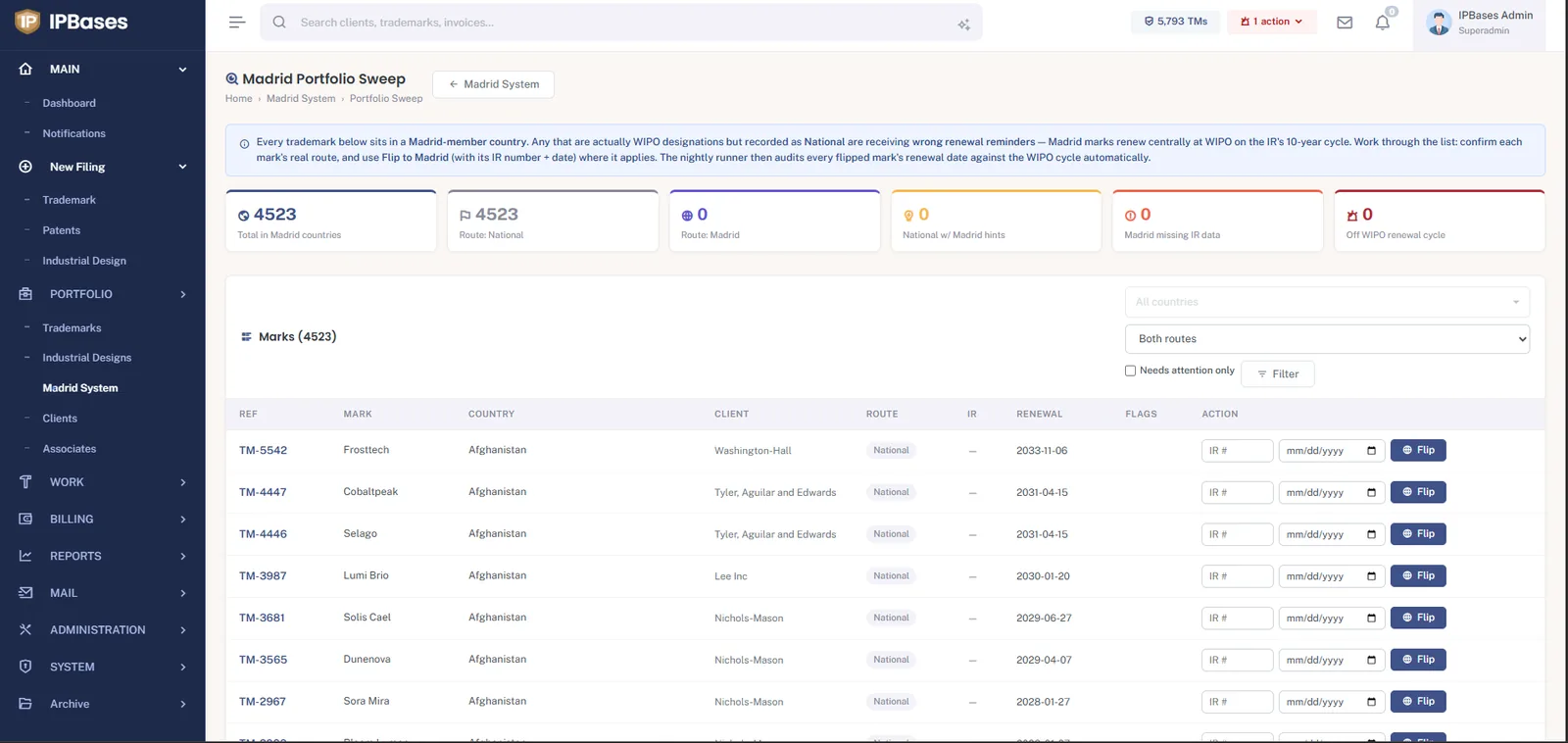
In practice, portfolios accumulate a specific kind of data-quality problem: a mark was actually filed through Madrid, but somewhere along the way it got recorded as a plain national filing — the IR number ended up in a notes field instead of a structured one, if it was recorded at all. That mark's renewal date is now wrong, because national and Madrid renewal cycles don't necessarily match.
A useful system doesn't just store Madrid data correctly going forward — it helps a firm find and fix marks that were mis-recorded in the past. That means scanning existing records for signals (an "IR" number pattern, mentions of "Madrid" or "WIPO" in notes or references) and surfacing the marks worth a second look, then correcting the record — reclassifying the filing route and recalculating the renewal date onto the correct WIPO cycle — in a couple of clicks rather than a manual audit.
The other practical benefit of modeling Madrid properly is reporting. Once designations are structured data rather than notes, a portfolio-wide view can answer questions like "how many of our Madrid designations are still open" or "which countries carry the most outstanding Madrid matters" directly — the same kind of jurisdiction-level reporting covered in our guide to trademark software for the GCC and Middle East, extended to cover international filings alongside direct national ones.
Updated August 2026: everything described above now ships as a dedicated Madrid module in IPBases, rather than a modeling recommendation:
For the full list of what shipped alongside it, see What’s new in IPBases (2026).
IPBases models Madrid Protocol registrations as International Registrations with per-country designations — not flat rows — with tools to catch and correct mis-recorded filings.
Book a demo → See pricing →