
The Madrid Protocol in 2026: filing, members, monitoring and renewal
One application, one language, one set of fees, and protection in up to 130-plus countries. Here is how the Madrid system works in practice, what changed in 2026 for the Gulf, and what to keep on your docket for the next ten years.
What the Madrid system is
The Madrid system, run by WIPO, lets a trademark owner protect a mark in many countries by filing one international application, instead of a separate application at every national office. The application is based on a mark already filed or registered at home (the basic mark), is filed through that home office (the office of origin), and names the members where protection is wanted (the designations).
The result is one international registration (IR) with one number and one renewal date, held at WIPO. Behind it, each designated office examines the mark under its own law and can grant or refuse protection for its territory. That split, one central record with many national outcomes, is the thing to understand about Madrid.
Who is a member in 2026
WIPO’s list of Madrid Protocol parties showed 117 members in October 2026 (WIPO, Madrid Protocol contracting parties). Two of them are intergovernmental organisations: the European Union, covering all EU countries with one designation, and OAPI, covering its African member states.
For firms in the Middle East and North Africa, here is where the region stands, with the date the Protocol took effect for each:
| Country | Madrid member since |
|---|---|
| Saudi Arabia | 8 October 2026 |
| Qatar | 3 August 2024 |
| United Arab Emirates | 28 December 2021 |
| Algeria | 31 October 2015 |
| Tunisia | 16 October 2013 |
| Egypt | 3 September 2009 |
| Oman | 16 October 2007 |
| Bahrain | 15 December 2005 |
| Morocco | 8 October 1999 |
Kuwait, Jordan, Iraq and Lebanon were not on WIPO’s list in October 2026, so marks there still need national filings. Membership changes, so check WIPO’s list before you advise a client.
New in 2026: Saudi Arabia joins
Saudi Arabia deposited its accession on 8 July 2026, and the Protocol took effect there on 8 October 2026. From that date, Saudi Arabia can be designated in new international applications, and owners of existing international registrations can add it through a subsequent designation.
- Saudi Arabia has declared an 18-month period to notify provisional refusals, rather than the standard 12 months, so final answers can take longer.
- The Saudi individual fee is CHF 1,397 per class (CHF 1,719 per class for collective or certification marks), on top of WIPO’s own fees.
- Saudi examination still applies: conflicts, registrability and the wording of goods and services are judged under Saudi law.
- Check that the protected versions of the mark include the Arabic version where the client uses one.
With Saudi Arabia in, five of the six GCC states can now be reached through Madrid. Only Kuwait still needs a national filing.
How a Madrid filing works, step by step
- Secure the basic mark. File or register the mark at the office of origin. The international application must match it: same mark, same owner, and goods and services no wider than the basic mark.
- File the international application through the office of origin. Name the members you want, list the goods and services in classes, and pay the fees in Swiss francs. The office certifies the application and forwards it to WIPO.
- WIPO checks formalities. If everything is in order, WIPO records the international registration, publishes it in the WIPO Gazette and notifies each designated office.
- Each designated office examines. It has 12 months, or 18 months where the member has declared it, to send a provisional refusal. Oppositions can extend that.
- Answer refusals locally. A provisional refusal is answered before that office, under its rules and deadlines, usually through a local agent.
- Protection is confirmed country by country. Each office sends a statement of grant, or a final refusal.
The five-year dependency, central attack and transformation
For five years from the date of the international registration, the IR depends on the basic mark. If the basic mark is refused, withdrawn or cancelled during those five years, the international registration falls to the same extent, in every designated country. This is known as central attack, because one successful action at home can undo protection everywhere.
The safety net is transformation: within three months of the cancellation, the owner can file national applications in the designated countries and keep the original international registration date. It works, but it costs a filing in every country, so the dependency end date and the health of the basic mark both belong on the docket.
Searching and monitoring international registrations
- Before filing: WIPO’s Global Brand Database lets you search marks from many national offices and the Madrid register in one place. It is a starting point; a clearance opinion still needs national searches in the key countries.
- After filing: Madrid Monitor shows the status and history of every international registration, including refusals and grants recorded by each office.
- Managing the IR: eMadrid is WIPO’s online service for the holder’s portfolio: renewals, and many requests such as recording changes, are made there.
Monitoring is where firms lose time. A designated office’s decision appears in Madrid Monitor, but someone has to notice it, put the response deadline on the docket and tell the client.
Renewing an international registration
An international registration lasts ten years and is renewed centrally at WIPO for all the members you keep, in one transaction (WIPO, renew your registration):
- You can renew up to six months before the ten-year term ends.
- After expiry there is a six-month grace period, with a 50% surcharge on the basic fee.
- Fees are a basic fee of CHF 653, plus a fee for each member kept, so check WIPO’s fee calculator just before paying.
- Renewal is done online through eMadrid, where marks due for renewal are flagged.
- WIPO sends an unofficial reminder shortly before the due date, but it is a courtesy, not a deadline system.
Because a Madrid mark renews at WIPO and not at each national office, it must not be docketed like a national mark in the same country. That is one of the most common Madrid docketing mistakes.
Keeping Madrid marks straight in IPBases
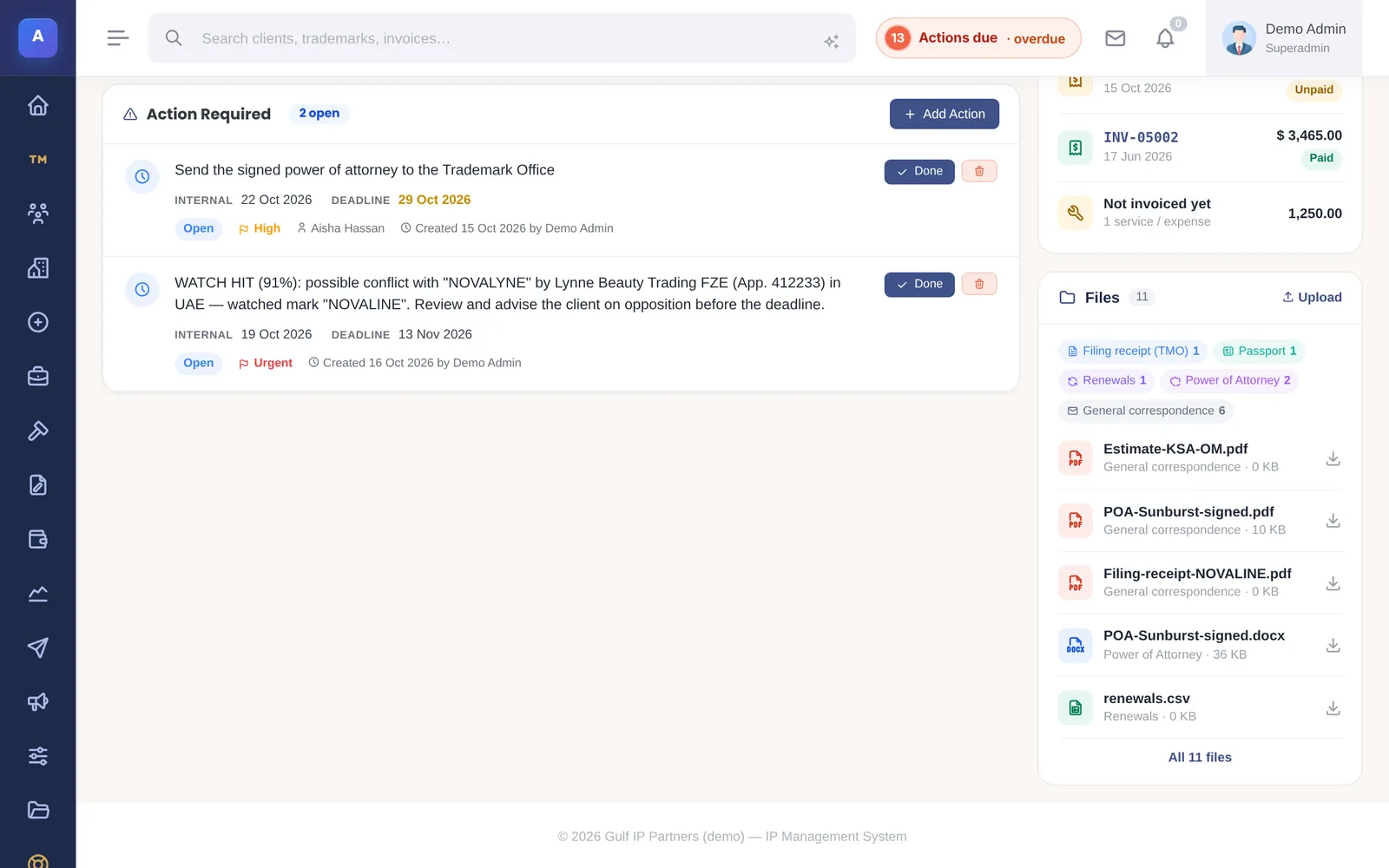
In IPBases, a Madrid filing is recorded as what it is: one international registration with a designation for each country.
- The IR record holds the IR number and date, the holder, the office of origin and the basic mark. The same IR number cannot be entered twice.
- The end of the five-year dependency period is set automatically from the IR date, with reminders before it ends.
- Each designation has its own status (pending, provisional refusal, granted, refused, ceased or transformed), its designation date and its refusal deadline, and can be linked to the national trademark record.
- If a central attack succeeds, recording it opens the three-month transformation window, with reminders.
- Renewal reminders for Madrid marks say clearly that the renewal is a WIPO central renewal.
A Madrid checklist for your docket
- Basic mark: number, status, and a watch on anything that could cancel it.
- IR number, IR date and the dependency end date (IR date + 5 years).
- Every designation with its own refusal deadline, using 18 months where the member has declared it.
- Local response deadlines for every provisional refusal.
- The three-month transformation deadline if the basic mark falls.
- One central renewal date, ten years from the IR date, with the six-month grace period noted.
- Subsequent designations, such as adding Saudi Arabia to existing IRs.
Frequently asked questions
How many countries does the Madrid Protocol cover?
WIPO listed 117 Madrid Protocol members in October 2026, including the European Union and OAPI, which together cover more than 130 countries.
Is Saudi Arabia part of the Madrid Protocol?
Yes. The Madrid Protocol took effect for Saudi Arabia on 8 October 2026. It can be designated in new international applications and added to existing registrations through a subsequent designation.
How long does a Madrid international registration last?
Ten years from the international registration date. It is renewed centrally at WIPO, up to six months before expiry, with a six-month grace period that carries a 50% surcharge.
What is central attack under the Madrid system?
For five years after registration, the international registration depends on the basic mark at home. If the basic mark is cancelled in that time, the international registration falls too, unless the owner transforms it into national applications within three months.