
Reporting to correspondents: what good looks like
Your notice is often forwarded straight to the brand owner. That makes every update you send to a correspondent a piece of their client service, and a reason for them to send you the next instruction, or not.
Your update travels further than you think
When you report a registration to a correspondent, they rarely keep it to themselves. They forward it to their client, sometimes with one line on top. The brand owner then judges the correspondent by what you wrote, how it looks and whether it answers their questions.
So the question for every notice is simple: could the correspondent forward this to their client without editing it?
The anatomy of a good update
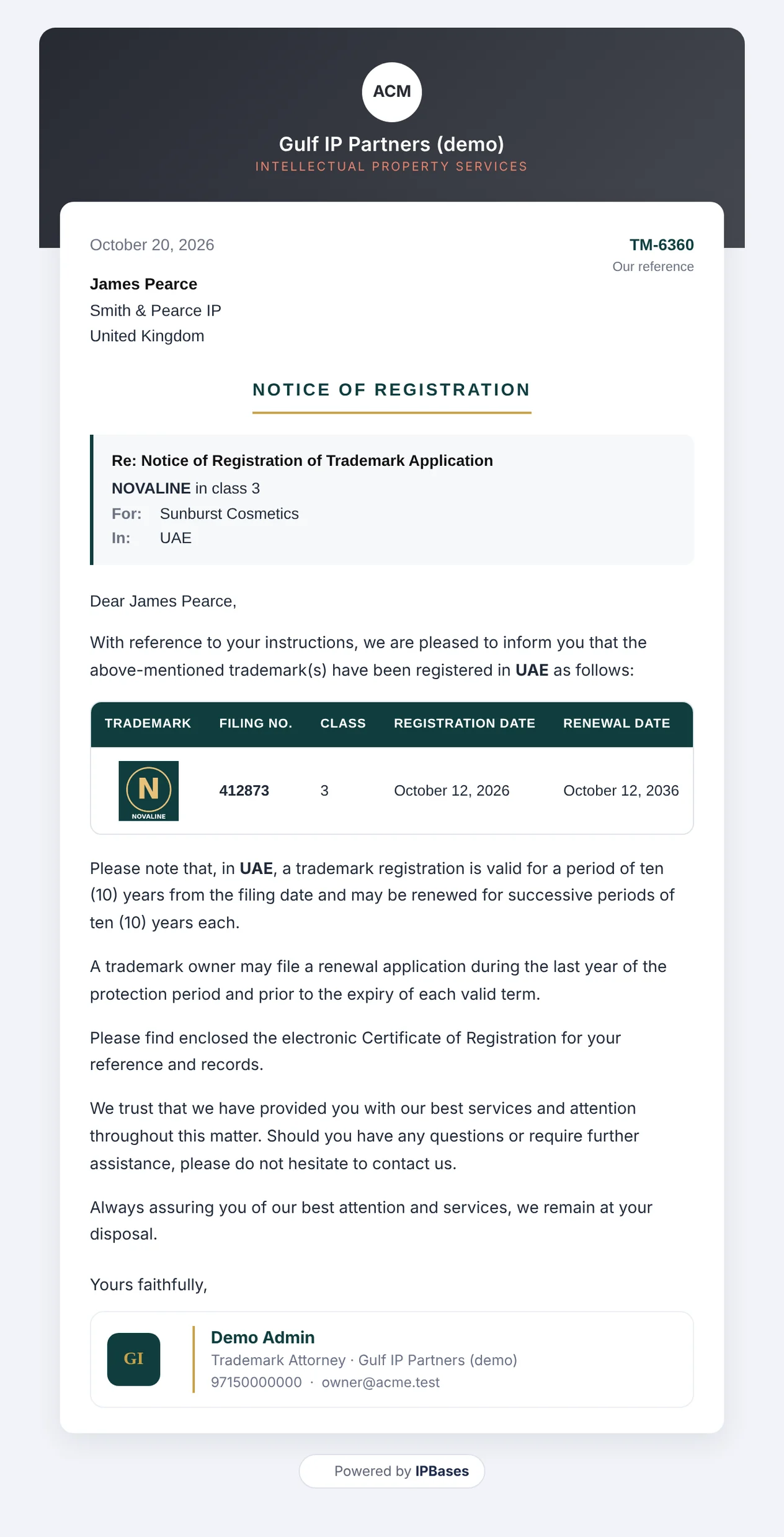
- A clear subject line: the milestone, the mark and the country, for example “Notice of Registration — NOVALINE in UAE”.
- Both references: theirs and yours, so it files itself on both sides.
- The mark at a glance: name, logo, class, owner and office.
- What happened: in one or two plain sentences.
- The key numbers and dates: application or registration number, registration date and the renewal date.
- What happens next: the next step and its deadline, even when nothing is needed from them.
- The documents: the official document or certificate attached, not just mentioned.
- A recognisable signature: the attorney’s name, title and direct contact details.
Which milestones to report
Report every point where something changed or a decision is needed:
- Filing, with the application number and filing receipt
- Acceptance, and what comes next
- Publication, with the opposition period
- Registration, with the certificate
- Refusal or office action, with the deadline to respond
- Documents needed, such as a power of attorney or specimens
- Publication and registration fee reminders, with the fee deadline
- Renewals, early enough to get instructions
Common mistakes
- A scanned letter with “please find attached”. The correspondent has to open, read and rewrite it before forwarding.
- Missing references. Their team has to search for which client and which mark it is about.
- No next step. They have to write back to ask what happens now.
- Different formats from different people. Inconsistency reads as disorganisation.
- The wrong language. An Arabic-only letter to a correspondent whose client reads English, or the reverse.
How IPBases sends it
In IPBases, the update is written from the trademark record. Pick the milestone and the email and letter fill in: the mark, numbers, dates, parties and the right wording for that stage, in English or Arabic. It goes out as a branded email in your colours, with the letter as a PDF on your letterhead, and at registration a certificate in your colours is attached automatically. Every update is kept in the mark’s history.
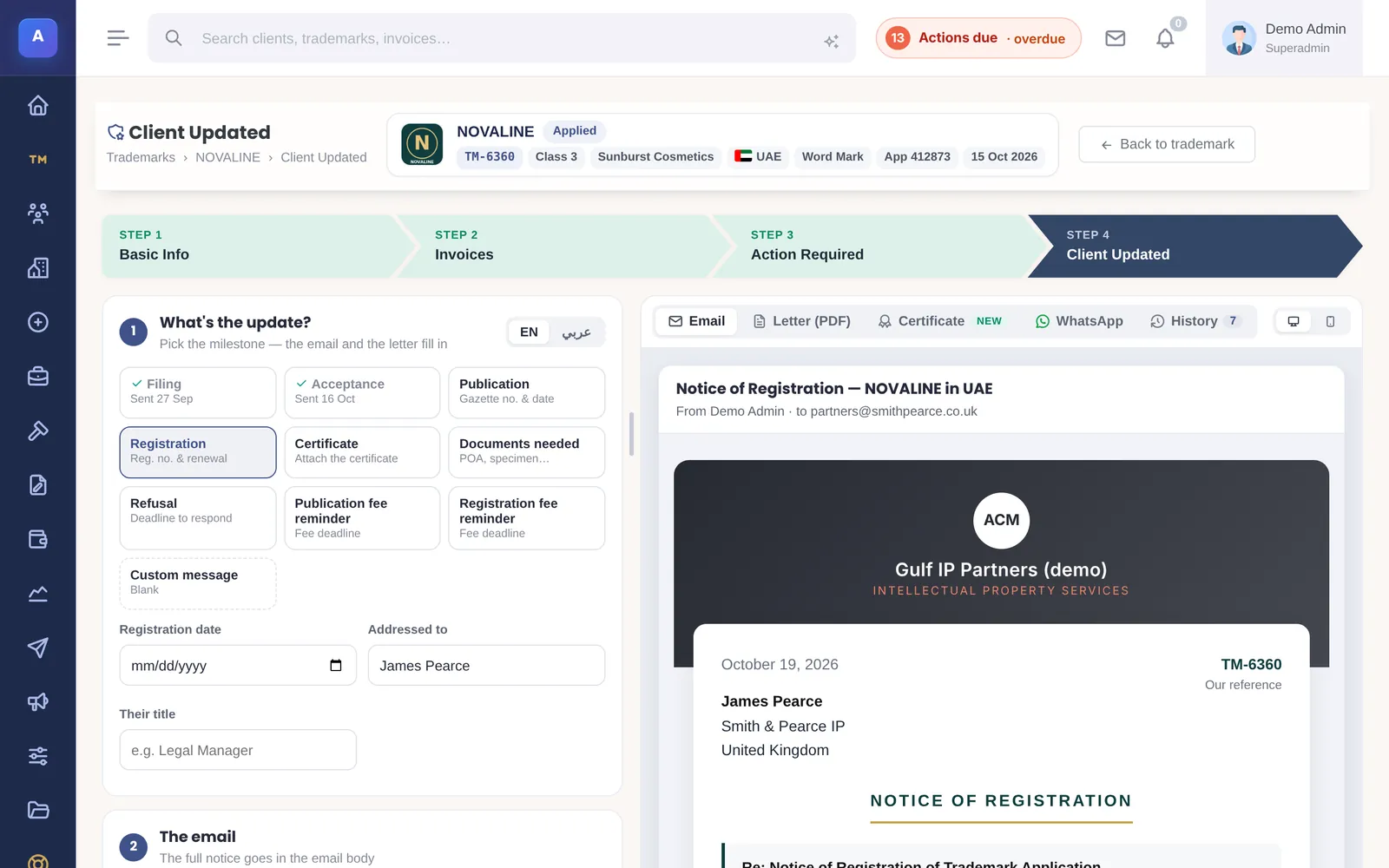
Because every notice comes from the same template, a junior paralegal’s update looks exactly like a partner’s, and that consistency is what correspondents notice.