
IP ERP vs CRM vs IP management software: what does an IP firm actually need?
Firms looking to modernise often start by searching for an ERP or a CRM. Both are reasonable starting points, and both miss the parts that make trademark and patent work different. Here is what each kind of system does, where the gaps are, and how to choose.
Why IP firms end up asking this question
The trigger is usually the same: the firm has grown past its spreadsheets. Deadlines live in one file, invoices in the accounting package, client emails in personal inboxes, and the foreign associates who send work are tracked in someone’s head. Management asks for “one system”, and the two kinds of business software everyone has heard of are ERP and CRM.
Both words describe something real that an IP practice needs. An ERP runs operations and money. A CRM runs relationships. The question is whether a general one, built for companies that sell products or services, can run a practice whose work is driven by trademark offices, statutory deadlines and correspondents in other countries.
What each kind of system does
| General ERP | General CRM | IP management software | |
|---|---|---|---|
| Built around | Orders, stock, accounts, staff | Contacts, companies, deals | IP rights: trademarks, patents, designs |
| Deadlines | Project or task dates | Follow-up reminders | Office deadlines, renewals and internal dates per right |
| Clients | Customer accounts for billing | Full contact history | Clients linked to the marks they own |
| Correspondents | Suppliers | Contacts | Associates who send or receive work, billed per matter |
| Billing | Strong: invoices, ledger, tax | Usually quotes only | Invoices with official and professional fees, per mark |
| Accounting | General ledger, payroll | None | Usually none: works next to your accounting software |
Read across the rows and the pattern is clear. A general ERP is strongest on the books; a general CRM is strongest on contacts; neither knows what a trademark is.
Where a general ERP falls short for IP work
- No IP record. There is nowhere natural for a mark, its Nice classes, its office, its filing route and its status. Firms end up with custom fields that only one person understands.
- Deadlines are not tasks. An office deadline has legal weight and often a second, internal date before it. Renewals recur on cycles set by law. A project-task module treats all of these as ordinary to-dos.
- Fees have two parts. IP invoices separate official fees, paid to the office, from professional fees. Many general invoicing modules can be bent to do this, but not per mark and per country without customisation.
- Customisation becomes the project. Making a general ERP fit IP work usually means a consultant, months of configuration and a system only the consultant fully understands.
Where a general CRM falls short
- Relationships without the portfolio. A CRM knows the client’s phone number, not which of their marks are due for renewal or under opposition.
- Correspondents are more than contacts. An associate who sends you work has clients, trademarks, rate cards and a balance with you. In a CRM they are a company record with notes.
- Correspondence is templated by event. IP firms send filing, acceptance, publication and registration notices, often in two languages. A CRM can send emails; it cannot write them from the trademark record.
- Deals are the wrong shape. A sales pipeline fits a one-off sale. IP work is a long relationship with a portfolio, where the “deal” is the next filing, renewal or opposition.
What an IP firm actually needs
Put the ERP and CRM halves together and take out what does not apply to a law practice. What is left is a short list:
- An IP record for every trademark, patent and design, with classes, status, office and route.
- Docketing with office deadlines, internal dates, renewals planned a year ahead and a person responsible for each action.
- Clients and associates linked to the rights they own or send, with their documents, correspondence and balances.
- Correspondence written from the record: client notices, letters and fee proposals, in each client’s language.
- Billing with official and professional fees, the right party invoiced, payments and balances in each currency.
- Portals so clients and correspondents can see their own records without emailing you.
- Permissions and an audit log, because a law firm must know who can see the finances and who changed what.
That list is what the market calls IP management software, or IP practice management software. When a firm searches for an “IP ERP” or an “IP CRM”, this is usually what it is looking for.
Keep your accounting where it is
One part of the ERP list rarely belongs in IP software: the books. General ledger, payroll, fixed assets and statutory accounts are well served by accounting packages, and accountants are trained on them. A sensible split is IP software for everything that touches a right, a client or an invoice, and the accounting package for the ledger. Ask any vendor how their invoices and payments reach your accountant before you sign.
Questions to ask before you choose
- Show me a trademark record. Where are the classes, the office, the status and the next deadline?
- How are office deadlines and internal deadlines kept apart, and who is responsible for each?
- Can I invoice the client or the foreign associate on the same mark, in the currency they pay in?
- Show me a client notice being created from the record. Can it be in Arabic, or another second language?
- What can a client or an associate see if I give them portal access?
- Who can see financial data, and where is the log of changes?
- Where is our data stored, and can we take all of it with us?
- How are our existing spreadsheets moved in, and who checks them?
Where IPBases fits
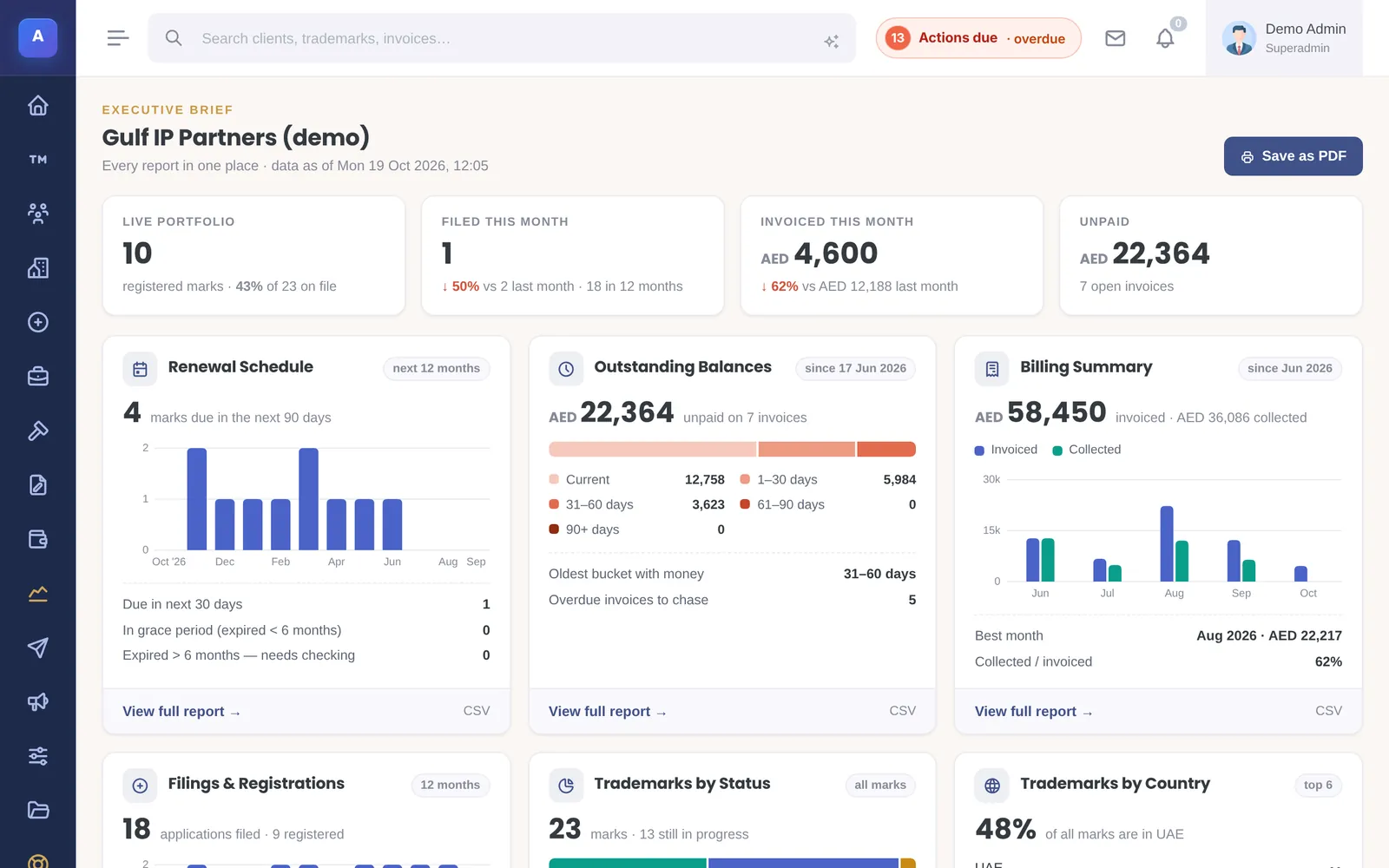
IPBases is IP management software that covers both halves for an IP practice. On the operations side: the portfolio, docketing, fee proposals, invoices, payments, expenses and reports. On the relationship side: clients, foreign associates, correspondence, notices in English or Arabic, and client and associate portals. Both sides share one set of records, installed on the firm’s own server under a one-time licence.
It does not replace a general ledger, payroll or HR system. For those, keep your accounting software. Read more on IPBases as an IP ERP and IPBases as an IP CRM.
Frequently asked questions
What is an IP ERP?
Software that runs the operations of an intellectual property practice: the portfolio of rights, deadlines and renewals, clients and associates, fee proposals, invoicing, payments and reports. Unlike a general ERP, it is built around trademarks, patents and designs.
What is an IP CRM or trademark CRM?
A CRM for IP firms: clients and correspondents are linked to the rights they own or send, with their correspondence, documents, invoices and balances on the same record.
Can a general CRM like a sales CRM manage trademarks?
It can store them as custom records, but it will not handle office deadlines, renewals, official and professional fees or notices written from the trademark record without heavy customisation.
Do we still need accounting software?
Usually yes. IP management software handles invoices and payments for the practice; the general ledger, payroll and statutory accounts stay in your accounting package.